Step into the early days of animation! In this hands-on workshop, participants bring drawings to life using a historical device – the zoetrope. This “wonder drum” experience is not only fascinating but also educational, playful, and creatively rewarding.
Zoetrope Workshop
Content
- What is a Zoetrope?
- Frame by Frame: You Make It Move
- Learning with Head, Heart, and Hands
- The Results Can Be Presented …
- Turning Topics into Motion – by Creative Learning
- Flexible and Modular – Four Building Blocks
- Framework & Group Size
- Trusted by Many – Selected References
- Curious? Here are Some Useful Links
What is a Zoetrope?
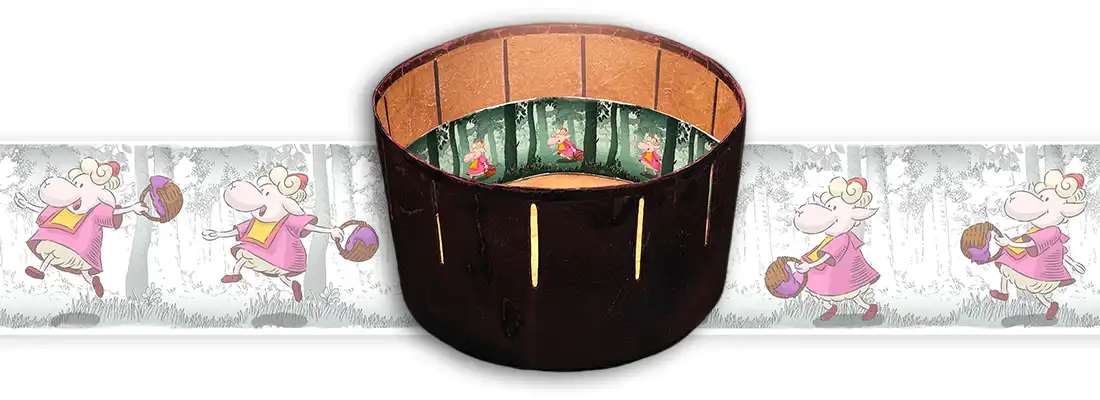
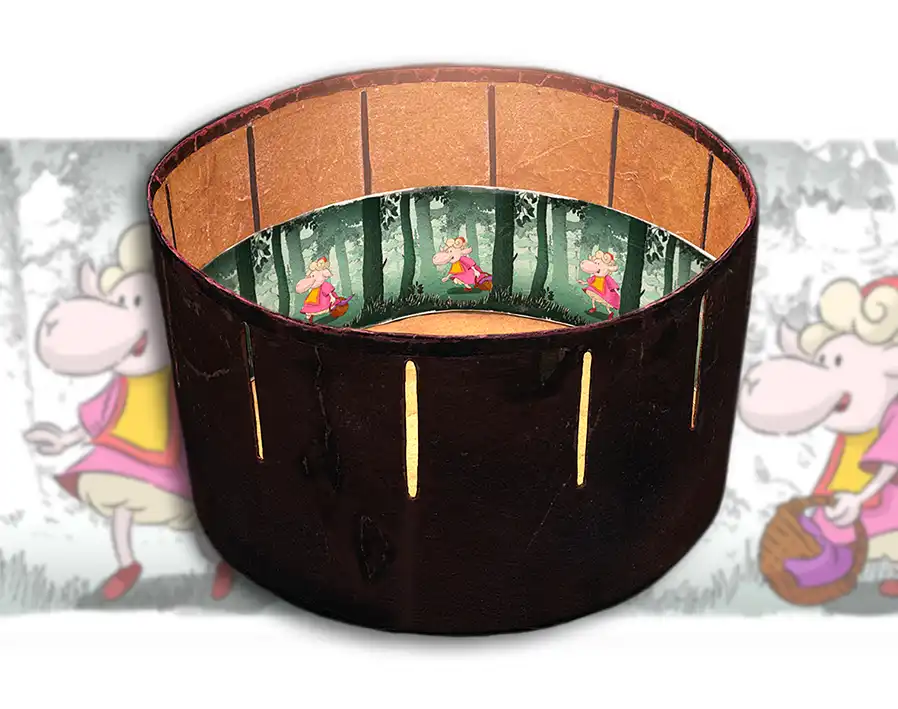
The zoetrope is an optical toy from 1834 – even older than cinema. It displays short, looping sequences such as a character walking, waving, or jumping. When a paper strip, like the one shown above, spins inside a zoetrope and is viewed through the slits, the drawings magically come to life. Watch the videos to discover how a zoetrope works and how animation is created on paper.
How does a zoetrope work?
(switch on the English subtitle)
Frame by Frame: You Make It Move
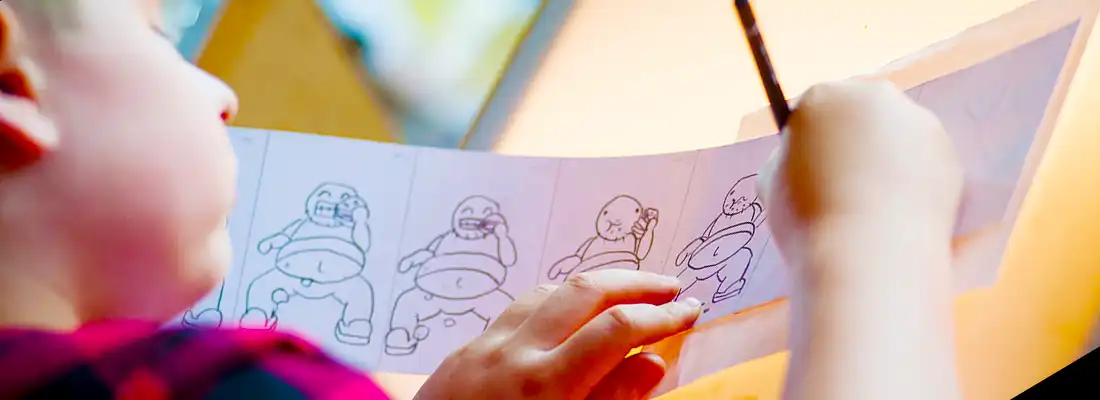
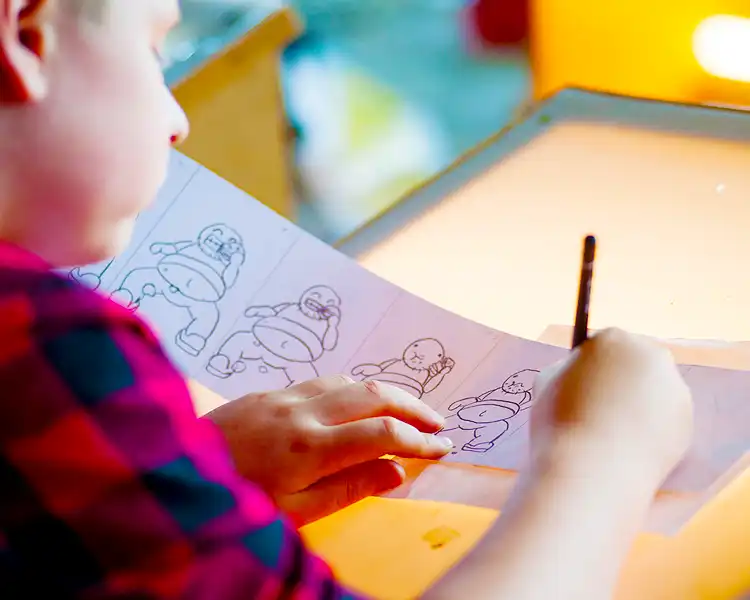
In the basic workshop (Module 1), participants create a short animation – a small story told within one second and drawn on a paper strip. The animation is tested directly in the zoetrope. The drawings are then refined until the movement appears smooth and the loop works seamlessly.
Each participant typically creates their own animation independently. However, animations can also be created collaboratively. For example, one person may draw the movement while another colours the characters or adds additional animated elements.
The creative process is playful and hands-on. Results become visible immediately and can be refined right away. Testing and presenting the animations together in the zoetrope or praxinoscope encourages lively exchange and discussion. The visible excitement and curiosity of the other participants often inspire new ideas and motivate further experimentation.
How does a paper strip become an animation?
(switch on the English subtitle)
Learning with Head, Heart, and Hands
The workshop combines artistic expression with technical understanding. Participants practice drawing and storytelling while learning the fundamentals of animation and physics. At the same time, they develop communication skills and build confidence in their own creativity. By viewing and discussing the animations together, participants learn to present their ideas, receive feedback, and learn from one another.
Report by the Hessian Broadcast TV about a zoetrope workshop
at the city museum of Kassel (in German)
The participants of the workshop gain:
- a sense for rhythm, movement and emotion
- an understanding of sequential visual thinking,
- fine motor and craft skills,
- an understanding of maths and physics as a tool
- a confidence through visible results.
It’s not just the mind that learns – the heart celebrates, along with others, what the hands have created.
How do I teach animation? (in German)
Excerpt from a documentation by students of the FOSBOS Straubing, 2018
The Results Can Be Presented ...
… spontaneously in a relaxed setting,
The finished animations are shown using the zoetrope and praxinoscope possibly accompanied by music. They are discussed in the group, and every result is appreciated, regardless of artistic level. Spontaneous guests are welcome to join the closing round and offer feedback to the creators.
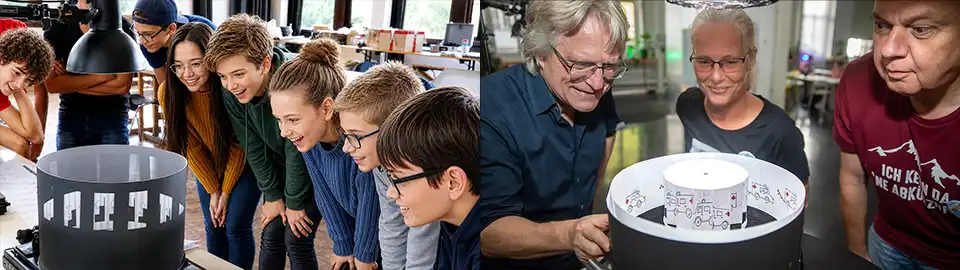
The zoetrope [left] was invented in 1834. The praxinoscope [right] from 1877 is a further development of the zoetrope.
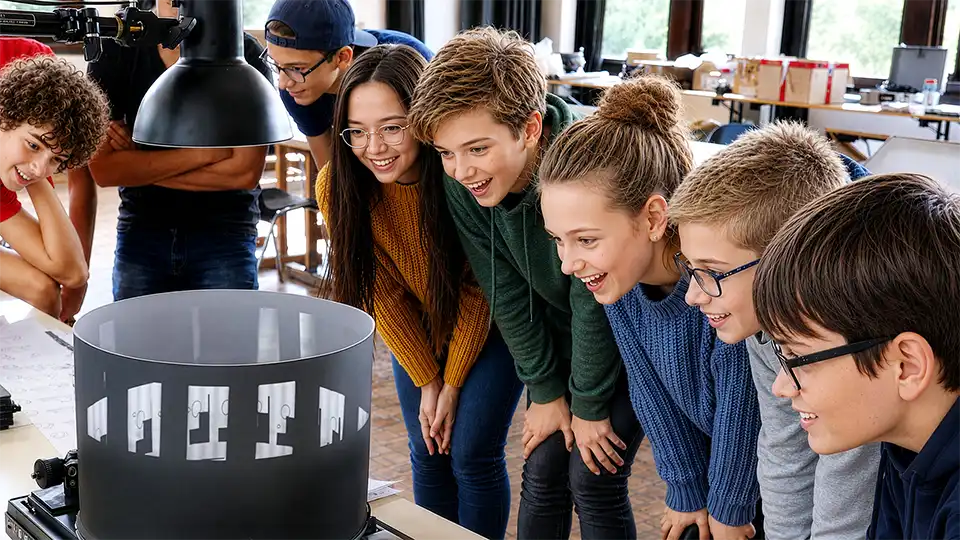
The zoetrope was invented in 1834.
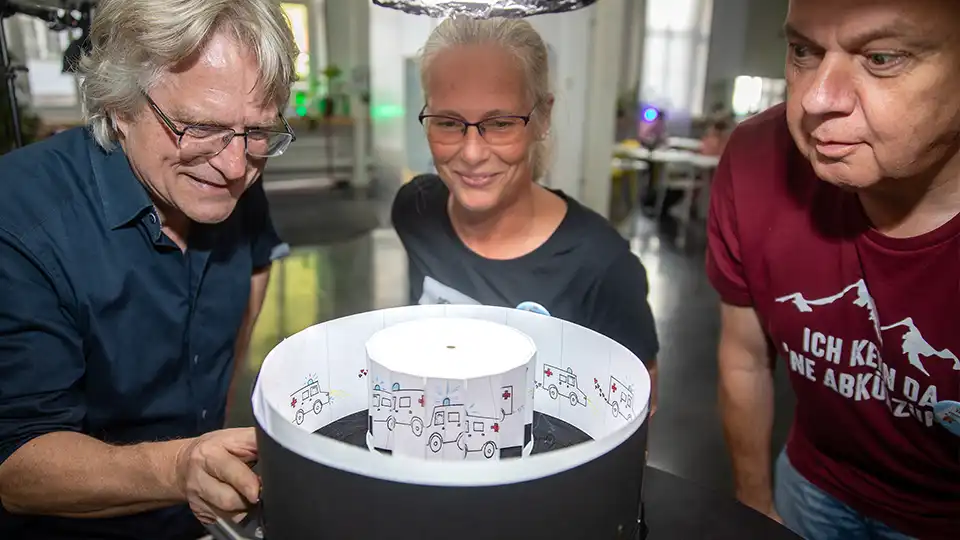
The praxinoscope from 1877 is a further development of the zoetrope.
… as an extraordinary audiovisual live performance or
In addition, the individual animations can be presented as a Spinning Animation Show – a live event combining projection, sound, and performance – presented with various optical devices such as zoetrope, praxinoscope or on a turntable with strobe light.
A Spinning Animation Show
presented by the federal prizewinners of the “Jugend creativ” competition in 2015.
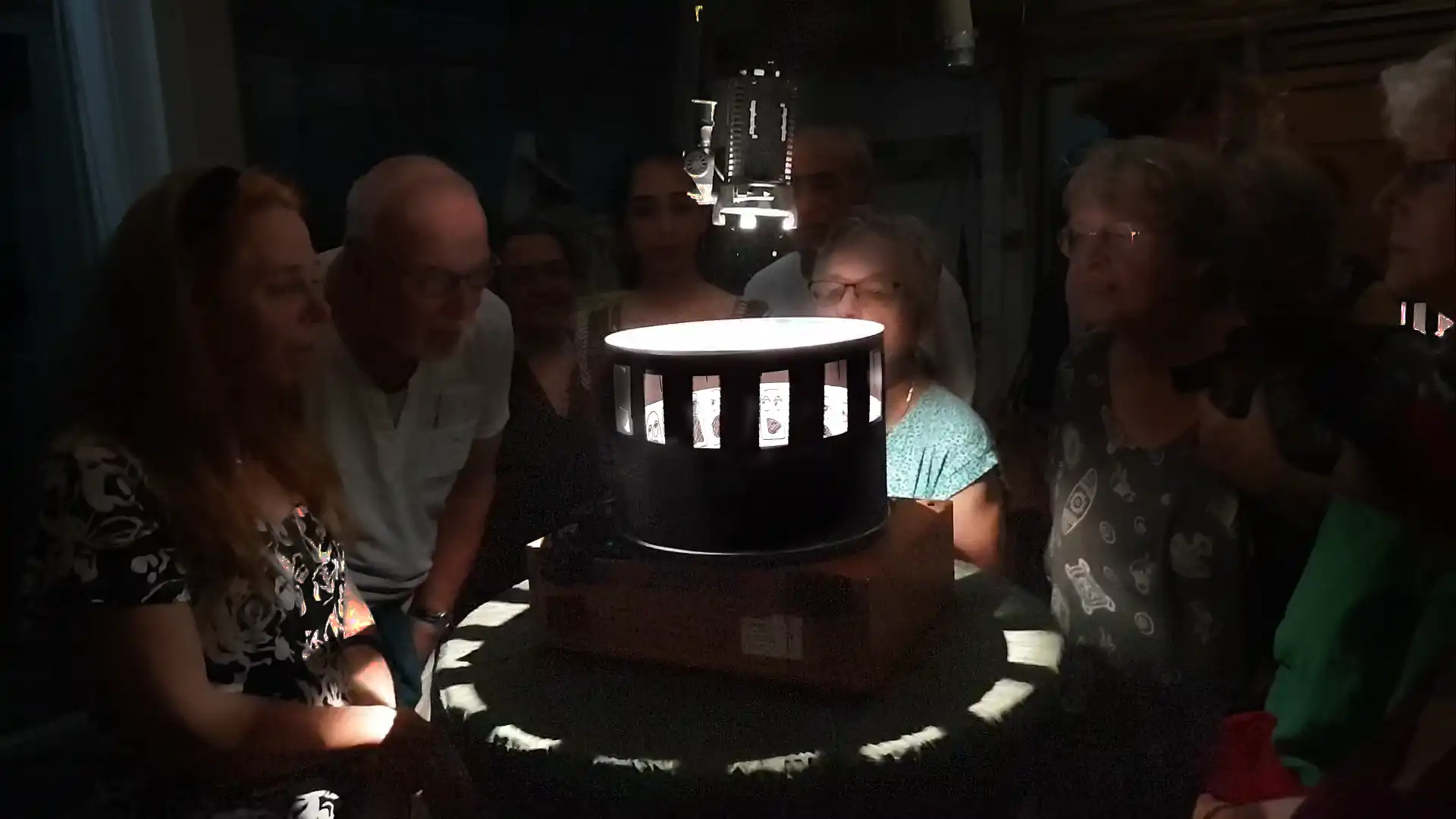
The Spinning Animation Show
at the German conference of puppeteers in Northeim in 2019
… as a film.
The animations on the paper strips can be turned into a short film with music, allowing the workshop results to be presented both on screen and online.
Paper strips with animation as film
animated by the participants of the Caricatura Summer Academy – in Kassel 2024
Excerpt of The Spinning History
(film version)
Turning Topics into Motion - by Creative Learning
In The Spinning History, for example, students of the FOSBOS – a specialised secondary school for design in Straubing, brought the history of the city to life: with 80 short animations, which they staged in a fascinating audiovisual presentation with eight different optical devices.
The zoetrope workshop is adaptable to various themes. Whether topics such as democracy, the environment or history – participants transform their thoughts into animated ‘mini films’, or more precisely, initially on strips of paper. This approach makes complex topics tangible and engaging.
Flexible and Modular – Four Building Blocks
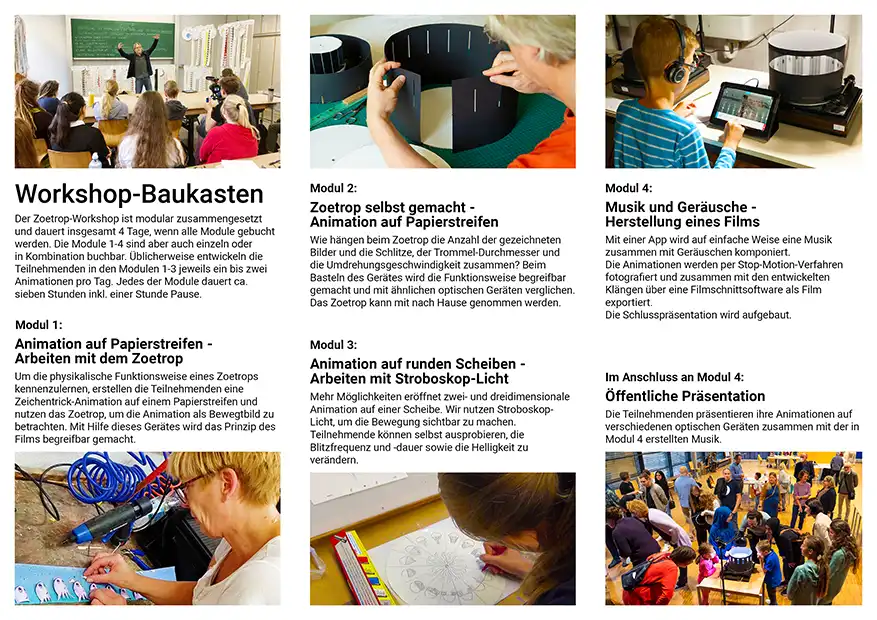
The zoetrope workshop can consist of up to four modules, which can be freely combined depending on your objectives and time frame. Each module can be conducted in a single day or over several days.
I recommend starting with module 1.
Open the a pdf-file of module 1 in German.
- Module 1: Drawing animation strips and presenting them with a zoetrope and praxinoscope
- Module 2: Building a functioning zoetrope
- Module 3: Animating on rotating discs using strobe light
- Module 4: Presenting the results as performance or as film with sound and music
Open the Flyer bellow in German.
How does a zoetrope work?
(switch on the English subtitle)
How does a paper strip become an animation?
(switch on the English subtitle)
Report by the Hessian Broadcast TV about a zoetrope workshop
at the city museum of Kassel (in German)
Report about a workshop with 4 modules
by Simone Klar (English subtitles)
recorded at the summer academy ‘Jugend creativ’ competition in 2015.
How do I teach animation? (in German)
Excerpt from a documentation by students of the FOSBOS Straubing, 2018
nur zur Ablage der Buttons
Füge diese zwischen Public presentation und Flexible syxstems … ein.
Take part in a zoetrope workshop
Visit our next presentation.
Framework & Group Size
- Minimum duration: 5 hours for up to 12 participants
- 13 or more participants: at least 6 hours required
- Target audience: Ages 10 and up; for schools, museums, festivals, families, art academies, and anyone interested in animation
Trusted by Many – Selected References
Click on ‘report’ to read about the respective workshop.
- Futurespace Kassel (STEM education center)
- Kassel City Museum (report)
- Grimmwelt Museum
- Caricatura Gallery Kassel – Annual summer academy for young cartoonists
- City of Straubing for the 800th anniversary celebrations in cooperation with the FOSBOS – Secondary technical school for design in Straubing (report)
- ‘Jugend creativ’ competition organised by the Association of Volksbanken and Raiffeisenbanken (BVR)
- School authority Kassel – Department for the promotion of gifted children
- Robert Bosch Foundation in cooperation with the German Film Museum Frankfurt
- Medland GmbH & Co. KG (report)
Workshops in other Animation Techniques
Curious? Here are Some Useful Links:
- See list of references.
- See for yourself: Experience reports in my blog about past zoetrope workshops.
- Watch clips and presentations on social media:


