Animation Workshops

Are you planning to organise an animation workshop? I have been offering workshops in a variety of animation techniques since 1996. Participants benefit from my many years of experience as a director, writer, producer and animator. I have been making animated short films since 1982 and have also worked on animated commercials.


What makes animation workshops special is the combination of different forms of artistic expression with the creation of movement over time. Drawings, figures, objects or even people are animated frame by frame. In this way, individual ideas are transformed into moving images, surprising transformations or short stories.


On this page, I introduce my five animation workshops, explain how they differ and provide information about duration, group size, equipment and costs. This will help you decide which workshop is best suited to your event. You can find more detailed information by following the links to the individual workshops.


I place great importance on professional standards and careful preparation when planning my workshops. At the same time, I aim to adapt my workshops to different budgets and organisational circumstances. To develop a suitable workshop concept and calculate the costs as accurately as possible, it helps if you explore the different workshop options in advance and provide me with specific information about your ideas and requirements.

Content

Which Animation Workshop Is Right for Your Event?

The workshops differ in their animation techniques, the scope of the production process, and their organisational and financial requirements.


The Zoetrope Workshop is particularly suitable for larger groups with limited budgets. Participants create short animations independently, learning the fundamentals of frame-by-frame animation. The technical and organisational requirements are comparatively low.


In the other workshops, participants work together in film teams to develop stories and turn them into animated films. They explore further stages of film production – from visual design and animation to camera work, editing and sound design. This requires more time, technical equipment and coordination within the teams, as well as additional supervision where necessary.

Zoetrope Workshop – Bringing Drawings to Life

Participants draw short sequences of movement on paper strips. When thezoetrope containing the paper strip is rotated and the drawings are viewed through its slits, the illusion of fluid movement is created.


Each participant develops their own animations and can immediately test andrefine them. They learn how to translate simple ideas into images and movementsthat communicate a clear message to the viewer.


The focus is on the fundamental principle of traditional hand-drawn animation: movement is created through a sequence of individual drawings. Each participant takes responsibility for every stage of the animation process – from developing an idea and creating the individual drawings to completing the animated sequence. No cameras, lighting or film editing are required for this basic form of animation.

Learn more: Zoetrope Workshop

Thomas Stellmach gives a young participant advice on his animation while sitting next to a zoetrope.

Learn more: Zoetrope Workshop

Cut-Out Animation Workshop – Telling Stories with Cut-Out Characters

Participants create characters and backgrounds using cut-out paper shapes, illustrations or photographs, animating them frame by frame. The flat elements are moved or replaced on a flat surface beneath a camera, making the technical setup comparatively simple. Cut-out animation is particularly well suited to making explanatory films, as even complex subjects can be presented clearly and effectively using simple visual techniques.


Unlike the zoetrope workshop, where each participant independently creates short animations, this workshop focuses on producing a film together. Participants first develop their own ideas, which they then refine into a shared story and bring to life on screen as part of a film team.


They learn how to divide the different stages of film production effectively. By taking on specific roles such as directing, design, animation, camera operation, editing and sound, they can contribute their individual skills and carry out several tasks simultaneously.


Working on longer scenes, participants explore animation timing in greater depth and learn how to communicate movements and actions clearly. Sound design, including sound effects, dialogue and music, can also be part of the filmmaking process.

Film still of a cut-out film, realized in a workshop by Thomas Stellmach

Stop-Motion Workshop – Animating Characters and Objects

Participants create and animate three-dimensional characters and objects, for example using modelling clay or other materials. They discover how the choice and creative use of different materials can produce distinctive and sometimes surprising visual effects.


Working in film teams, they develop short stories, create characters and film sets, and bring their ideas to life on screen. They learn how to compose three-dimensional scenes, light film sets and use different camera angles to achieve specific dramatic effects. The more elaborate setup of three-dimensional film sets makes it particularly useful to divide tasks within the film team, for example in character construction, set design, lighting, camera operation and animation.


Animating three-dimensional characters is particularly demanding, as movements and poses must be carefully adjusted in three-dimensional space, frame by frame. Participants also experiment with transforming characters and materials expressively through gradual changes. The additional work involved in character construction, set design, lighting and animation makes it particularly useful to divide tasks within the film team.

Learn more: Stop-Motion Workshop

A dinosaur sculpted from blue modeling clay is brought to life by hand using stop-motion animation.

Learn more: Stop-Motion Workshop

Pixilation Workshop – Animating People Frame by Frame

In pixilation, people are animated like cartoon characters. Frame-by-frame filming creates unusual movements and surprising situations in which people and animated objects appear to interact effortlessly. What makes this technique special is that these effects are created directly on set during filming, without the need for complex digital compositing in post-production.


Working in film teams, participants develop their own ideas and take on different roles in film production. They learn to observe human movement closely, break it down into individual phases and plan it frame by frame. By using their own bodies, they gain a direct understanding of how animation works.


A particular challenge is the collaboration between the director, camera operator and performers. Movements and actions must be carefully planned and precisely coordinated for each individual frame. This requires discipline, patience and concentration from everyone involved, as well as good body control from the performers.

Learn more: Pixilation Workshop

Film still from the pixilation film ‘Bettenwechsel’, engl. ’Changing Bed’. A teenager is lying on the ground while creating a stop-motion walk cycle using his own body.

Learn more: Pixilation Workshop

Paint-on-Glass Animation Workshop – Creating Moving Images with Paint

Participants create images using non-drying paints on a glass plate. They modify the images step by step, photographing each stage. This creates fluid movements and transformations. As entire areas of colour must be modified frame by frame, with careful attention to the distribution of paint, textures and subtle variations in colour, this animation technique is particularly time-consuming.


Working in small teams, they experiment with shapes, colours and different tools. Depending on how they apply, spread or manipulate the paint, they can create distinctive textures and visual effects, which they can deliberately incorporate into their animations.


Through this process, participants learn how to bring their own ideas and stories to life visually using this distinctive technique. They develop a sense of timing, visual composition and the wide range of expressive possibilities offered by colour and texture.

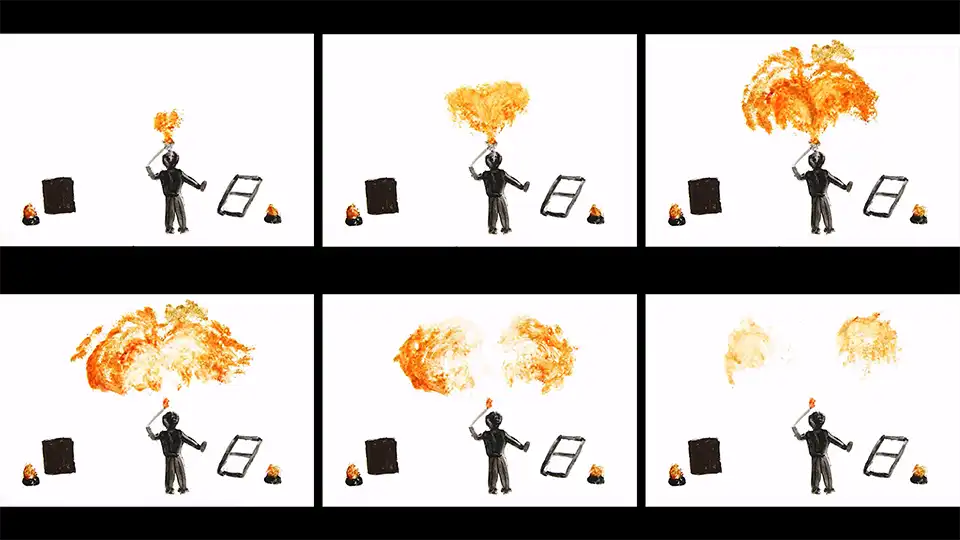
A sequence of images from a color-on-glass animated film shows a fire-breathing cartoon character.

Creativity, Themes and Teamwork

The workshops offer many opportunities to develop creative ideas and discover artistic abilities. Depending on the animation technique and project, participants explore storytelling, dramatic structure, visual expression and the creative use of music and sound effects.


The workshops can also explore predefined themes, for example from projects organised by schools, cultural institutions or companies. Teachers can work on curriculum-related topics with their students in advance. This preparation may lead to initial ideas or even complete stories that can then be brought to life through animation during the workshop.


While participants in the zoetrope workshop can work independently, the other workshops are designed around collaboration in film teams. They divide responsibilities, coordinate their work and share responsibility for the final result. This encourages team spirit, motivation and reliability. The workshops can also reveal particular talents or spark new interests.

Duration, Group Size and Results

How Much Time Should Be Allowed?

A zoetrope workshop can be held in just one day. However, I recommend at least two days. On the first day, participants put their own ideas into practice. Building on this experience, they can then create more sophisticated animations.


For cut-out animation, stop-motion, pixilation and paint-on-glass workshops, I recommend at least three days for participants without previous experience. For participants with prior experience, two days may also be sufficient, depending on the workshop concept and desired outcome. One-day workshops are also possible in these techniques, but focus on practical exercises and short animation clips rather than producing a complete short film.


The appropriate duration also depends on the number of participants and the desired outcome.

How Many People Can Participate?

For more individual guidance, I recommend a group size of around 12 participants. Depending on the workshop type, duration and available supervision, groups of up to 20–25 participants are possible. However, not every animation technique is equally suitable for larger groups.


In the zoetrope workshop, each participant creates their own animation strips. In cut-out animation, stop-motion, pixilation and paint-on-glass workshops, participants usually work in small teams. The appropriate team size depends on the animation technique and the tasks involved.


The number of film teams also determines how many animation stations, pieces of equipment and supervisors are needed.

What Results Can Be Achieved?

Depending on the workshop, participants create individual animations, short movement sequences or collaboratively produced animated films.


In the zoetrope workshop, animations can be viewed directly using the optical devices and presented live. Simple digital film clips can also be created by filming the moving animations on a zoetrope or praxinoscope. For higher image quality, the individual animation frames can be photographed and assembled into a film with music and sound effects. This can take place during the workshop if a suitable computer with the required software and someone with the necessary expertise are available. Otherwise, the film can be completed after the workshop.


In cut-out animation, stop-motion, pixilation and paint-on-glass workshops, individual frames are captured using a digital camera, webcam, smartphone or iPad with suitable animation software. Completing the films may require editing, music and sound design.


Whether a fully edited film can be presented during the workshop or requires additional post-production depends on the workshop duration, the scope of the project, and the availability of suitable technical equipment and experienced support.


The desired outcome and the format of any final presentation should therefore be clarified at an early stage.

Space, Equipment and Supervision

The space and technical requirements vary depending on the workshop. I can provide some of the necessary equipment myself. Any additional equipment or facilities required will depend on the animation technique, the number of participants and how the workshop is organised.


For the zoetrope workshop, I provide the necessary optical devices and light pads. Neither cameras nor computers are required for the basic animation process, making the technical and organisational requirements comparatively simple.


Cut-out animation, stop-motion, pixilation and paint-on-glass workshops require cameras, lighting and other technical equipment. Depending on the workshop and the number of film teams, several animation stations or film sets may be needed.


Pixilation requires suitable filming locations with enough room for movement. If several film teams work simultaneously, additional rooms or filming locations may be necessary.


If the films are to be edited and sound added during the workshop, suitable computers with video editing software must be available.


To keep technical requirements and costs as low as possible, it is important to clarify in advance what facilities and equipment the organiser can provide. Useful resources include film studios, stages with lighting equipment, workshops with tools, as well as cameras, computers, iPads or smartphones with suitable animation software.


Teachers and other accompanying adults can help with organisation and educational supervision. Depending on the workshop, teachers or participants with relevant technical or creative skills can also assist with film production.


When several film teams work simultaneously, additional support may be needed, particularly if the teams are filming at different locations.

Costs and Funding

Costs depend on the type of workshop, its duration, the number of participants and the equipment required. Existing facilities and equipment, as well as assistance from teachers or other support staff, can help reduce additional expenses.


My standard hourly rate is €120 net for workshop planning, preparation, delivery and follow-up work. Even one-day workshops involve preparation and organisational work that is necessary regardless of their duration. For workshops lasting several days, this work is spread over a longer period, resulting in a reduced hourly rate. I also charge a lower hourly rate for loading, setting up and dismantling the workshop equipment.


Additional fee reductions may be available for schools, cultural and educational institutions, depending on the project and available funding.


In addition to my fee, there may be costs for special materials, the provision and insurance of technical equipment, travel and equipment transport. Accommodation costs may also apply.


Before making an enquiry, please find out what funding options are available through your organisation and who can cover the costs. Please also check whether your organisation or the funding body has any specific requirements or maximum fee limits, and which additional expenses, such as materials, technical equipment, travel and accommodation, can be covered.

Workshop Combined with an Animated Film Show

The workshops can be combined with my Animated Film Show, in which I present my award-winning short films. Having gained their own experience with animation, participants can view the films from a new perspective and gain a better understanding of their artistic and technical design.

Read my experience reports about the combination.

References

BVR – Bundesverband der Deutschen Volksbanken und Raiffeisenbanken (National Association of German Cooperative Banks)

On behalf of the BVR, I conducted week-long animation workshops each year from 2006 to 2019, using a variety of animation techniques. The workshops were designed for German prize-winners of the European jugend creativ competition.


The results of each workshop were presented at a final event, either as a film or as a live performance called The Spinning Animation Show.


Each workshop at the jugend creativ Bundespreisträgerakademie (National Prize Winners’ Academy) explored a specific theme, such as ‘Imagine’, ‘Balance’, ‘Bridges’, ‘Flow’ or ‘Oikos’.


  • Participants and group size: 6–12 students aged 12–19
  • Duration: 6 days, including a final presentation
  • Animation techniques: Traditional animation, cut-out animation, stop-motion, pixilation, paint-on-glass animation and experimental techniques
  • Venue: Internationale Bildungsstätte Jugendhof Scheersberg, Germany
  • Staff: 1 educational assistant


Watch the workshop animations on Vimeo.

A glimpse into an animation workshop

Goethe-Institut Amman, Jordan – Royal Film Commission Jordan

On behalf of the Goethe-Institut, I conducted a stop-motion workshop in Amman in cooperation with the Royal Film Commission Jordan.


Participants built wire figures and gained practical experience in stop-motion animation and frame-by-frame filming techniques.


  • Workshop language: English
  • Participants and group size: 12 animation trainees and professionals
  • Duration: 3 days
  • Animation technique: Stop-motion with puppets made from wire and plasticine
  • Venue: Royal Film Commission Jordan (RFC)
  • Staff: 1 assistant

Photos from the workshop

City of Straubing – FOSBOS Straubing, Germany

To mark the celebrations of ‘800 Jahre Neustadt Straubing’ (800 Years of Straubing’s New Town), the City of Straubing commissioned me to conduct a zoetrope workshop, culminating in a presentation of the results as The Spinning Animation Show.


In collaboration with the Straubing City Archives and FOSBOS Straubing, I developed a 35-minute Spinning Animation Show entitled The Spinning History as part of a six-month zoetrope workshop. In this elaborate audiovisual presentation, the students brought the history of Straubing to life.

Excerpt of 80 cycle animations.

The workshop participants created 80 animation loops depicting historical events in Straubing. Each loop consisted of 15 individual images created on paper strips, paper discs, vinyl records or transparent Plexiglas. They presented their animations using eight optical devices, including zoetropes, praxinoscopes and turntables combined with stroboscopic and UV lighting.

  • Participants and group size: 30 students specialising in art and design
  • Duration: 6 months, including 4 workshops at the school and ongoing project support from Kassel
  • Animation technique: Animation loops using 2D techniques (drawing, painting, photo collage) and 3D materials (plasticine, folded paper, grains, cotton wool, string, etc.)
  • Venue: FOSBOS Straubing, Art and Design Department
  • Staff: Collaboration with the school’s regular art and design teaching staff


Read more about the workshop and presentation in my article The Spinning History – A Zoetrope Animation Project.

Report by Donau TV

Robert Bosch Stiftung, Berlin – Deutsches Filminstitut & Filmmuseum, Frankfurt, Germany

Together with Maja Oschmann, visual artist and co-director of VIRTUOS VIRTUELL, I conducted a one-day workshop on music visualisation.


Under the guidance of Maja Oschmann, participants drew on paper using charcoal or black ink. Through their drawings, they expressed the emotions evoked by the music they were listening to.


In the second half of the day, I led the workshop. Participants drew, modelled or created collages to produce animation loops on paper strips. Afterwards, they viewed their animations in a zoetrope while one participant provided a live musical interpretation of the results on the violin.


  • Participants and group size: 20 museum, theatre and art gallery educators
  • Duration: 1 day
  • Animation technique: Painting on paper in response to music, animation on paper strips
  • Venue: Kinder-Künste-Zentrum, Berlin

Photos from the workshop

Further References

  • Gymnasium An der Stenner, Iserlohn (Read a report.)
  • Filmakademie Ludwigsburg, Baden-Württemberg, Germany
  • University of Television and Film Munich, Germany
  • Jugendbildungswerk Hanau, Germany
  • Academy of Media Arts Cologne, Germany
  • Kassel School of Art and Design, Germany
  • Ludwigsgymnasium Straubing, Germany (Read a report.)
  • State Academy of Fine Arts Karlsruhe, Germany


Explore more events in my event archive.

Enquire About a Workshop

If you would like to organise an animation workshop, please describe your ideas, requirements and circumstances as accurately as possible in the contact form below.


Information about the participants, workshop duration, desired outcomes, and available organisational and financial resources will help me assess which workshop is suitable for your event and feasible under the given conditions.


If some details have not yet been decided, you can indicate this in the form.